I’ve just dished out my novelette, ‘Branching Out’, to some beta readers and will be starting the 4th draft of my 2nd novel, ‘Broken Branches’ which means soon I will have nothing else to write about, so now’s a good time to think about starting a 3rd novel.
I was in this position in November 2009 when I had a vague idea of what to write for my 2nd novel…even though it turned out different, I still had a starting point.
This time I have nothing.
Well, not completely zilch. A theme I’m interested in is the distribution of wealth after the financial crash, Occupy, 99%, MP’s expenses, lobbying, etc, etc. This theme in itself doesn’t make for an interesting story but it’s a starting point for imaging a world and placing characters in it.
I think the hard part is thinking of a hook for a story. Picking a theme you’re interested in is easy enough but finding a story within that theme and telling it from an interesting angle with compelling characters driving the story down a road with surprising twists to a satisfactory destination is another ball game.
That’s when I thought about cheating : )
I’m a grown man and I’ve just spent time cutting out teeth to create this photo of a laptop eating an iPad.
I need to get a life.
Anyway, writing machines, which is best?
I love both and I did give my iPad an honest go of being my go-to scribing tablet but it didn’t quite cut the mustard.
It has no keyboard, so I bought an external one. That does improve things but my main issue was the lack of cursor. Touching the screen to direct the cursor meant my fingers weren’t near the keyboard which was a little weird. Using the arrow keys is another solution but a very clicky one especially if you’ve got to go back a few paragraphs and delete a sentence.
An external keyboard also means your singular, sleek slice of serenity is now a two-piece. If I wanted a two-piece I’d grab a notebook and pen. I’m too high-tec for that kind of malarkey.
Man! Am I the laziest blogger ever?!
Been writing a short story, ‘Branching Out’ which is a prequel to my second novel ‘Broken Branches’. Originally thought it would be 2,000/3,000 words, so far I’m on 8,500 and it’ll clear 10,000 easy (which classifies it as a ‘Novelette‘, apparently).
Also, between the last post and the present day, my laptop slowed down to a pace which tempted violence, so I sucked it up and bought a second-hand Mac Air.
Searched for a writing app to go with it and stumbled on MOAppsWrite.
Sweet joyousness followed, along with a severe lack of blogging.
I used to use Microsoft Word for all my writing needs and don’t have a bad word to say about it. It can be overkill but you can rearrange the toolbar settings to have minimal features showing allowing you to get on with the business of scribing.
I thought I’d get involved in Chuck Wendig’s flash fiction competition, 100 words on the theme ‘revenge’. Editing this to the bare bones to meet the word count proved harder than vomitting forth the first draft, so here it is…
Mr Kingston sat coiled in his chair, scrutinising Mr Harris at the podium,
“Thank you, Headmaster. As new Head of History…”
The hall doors opened. Mr Kingston’s head remained fixed as his periphery vision investigated approaching footsteps.
“…ahem. History has a way of revealing…”
Two policemen sailed in; one remaining by the stage, the other conferring with the headmaster. Whispering pupils left in their wake.
The headmaster interrupted the coronation, “Thank you, calm down. Mr Harris, if you’d follow the sergeant, I’ll finish assembly.”
Mr Kingston chewed on a sneer.
“Sir, what’s happening?”
“Shut up, Jenkins.”
I recently read ‘Why I Write‘ by George Orwell and within the essay ‘Politics and the English Language’ lie the ‘writing rules’ sometimes quoted on Twitter and elsewhere online.
It’s an interesting essay where he points out that jargon, unoriginal metaphors, padding and ‘humbug’ are used increasingly in politics and creeping into other literary arena’s.
Bear in mind that this was written in 1946 so he’s rapidly spinning in his grave at the moment.
The fact George frequently uses the word ‘humbug’ throughout this book is an unmitigated joy.
His rules are;
In a shameless act of self-promotion, I wrote an article and submitted to Joanna Penn who runs ‘The Creative Penn‘.
Joanna’s published it here today, ‘Writing Tip: Creating a Visual Character Map‘.
If you’ve come here from there, hello!
@iainbroome posed the tweet;
About to record WfYL podcast. Quick poll: what motivates you to write?
I replied;
Finishing something I created.
Finishing is what really gets me on the laptop and hitting those keys. I could think about ideas and story-lines all day without lifting a finger but compiling all those ideas and story-lines into some kind of semi-cohesive structure is what gets the laptop cracked open.
In the famous words of Chuck Wendig;
Finish the shit that you started.
It’s the No.1 rule in his piece, ‘25 Things You Should Know About Writing a Novel‘. His No.1 rule, so it’s not one of those ‘rules are meant to be broken’ rules. It’s a steadfast, rigid, unbendable rule like starting a sentence with a capital letter.
Yes, I’d like to be read and admired, have people fawn over my mind-bending, world changing ideas, get paid, get laid, get wined and dined, who wouldn’t? But I don’t think an unpublished writer without any literary background can begin with these elevated ideas of achievement, it doesn’t seem to be a healthy relationship to have with your own writing. Ego-stroking and material gain as motivation before you’ve even finished anything keeps your eyes on glittery distractions rather than your story.
When I start, my only goal is to finish. After I’ve finished then I dream of million pound book deals, a supermodel on my arm and supercars decorating the obscenely long driveway with a statue of myself in the centre…seriously.
This reminded me of a favourite book of mine when I was a kid, ‘The Magic Paint Brush’ (See video above). A boy gets a paint brush and as soon as he finishes painting something it becomes real. Your novel is nothing until it’s finished. It’s an unfinished novel. It can’t be rewritten, changed, fixed, improved or edited until it’s finished. As soon as it’s finished, your novel becomes real, opening the floodgates to more hard work, but at least you’re working on a completed manuscript, something which has a beginning, a middle and an end. You can see the whole picture and all the story arcs heading towards a satisfying conclusion.
I didn’t want to be someone who said ‘I think I could write a book‘ or have a half-hearted couple of chapters sitting in a drawer somewhere. I’ve started two novels and I’ve finished two novels.
Money and adoration can wait…for a little bit longer!
I recently bought an iPad, downloaded the iBooks and Kindle apps and started scouting for freebies.
What I found was a wealth of copyright expired classics swaddled within the damp, soiled rags of negligent designers.
In this day and age, classics should be treated with a little more care and attention…and here is my idea.
Amateur, student, professional designers should be donating beautiful cover artwork to dress these epic texts up so they can continue living long and productive lives for new readers who maybe put off with such staid and boring covers.
A printers opened up near me, infact, it’s technically the nearest retail establishment to my flat. This maybe a coincidence but I like to think of it as fate.
So it would be rude not to go to them to get my 3rd draft printed to dish out to some local beta readers. Pictured is the result. 6 manuscripts printed; 1 for me, 4 for others and 1 spare incase someone else nearby wants to give it the once-over.
Living during these heady first days of the ebook revolution, it’s always nice to see your novel in the flesh of printed paper.
I’m going to give it a month or two before I read through it again, just to have a rest and try to approach it again with some semblance of freshness.
I broke a few manuscript formatting rules because I’m giving it to beta readers and not submitting it to agents/publishers.
That’s it! 3rd draft done and dusted.
The next stage for me is to get feedback. I’m blind to the multitude of errors, faulty plot points, grammatical mistakes, lack of character development, personal writerly foibles and general shoddiness.
I can’t see the wood for the trees.
So here’s where YOU can fit in. You can be one of my beta readers!
Sarah LaPolla wrote a good piece recently concerning recruiting beta readers in her blog post - The Beta & the Omega:
…the advent of online forums and blogs and Twitter have made finding beta readers that much easier and that much more common. And most times you never even meet them in person.
So I’m putting her words to the test. This is a call out to the internet to get some beta readers.
Show the dog the rabbit!
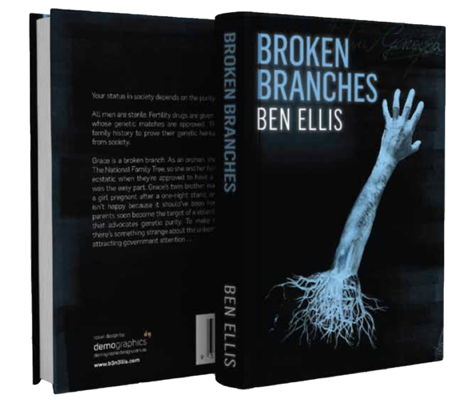
OK, so I finished my novel, ‘Broken Branches’. It’s 60,000 words long. I suppose it would be filed in the science fiction section but it’s more of a dystopian story. There’s no aliens, spaceships, ray-guns or airships with steam powered bazookas. Sorry.
Here’s some blurb;
The UK prides itself on a population connected by heritage, improving every generation via meticulous compatibility testing based on the potential child created, not love. A ‘parental democracy’ drives this development, approving or denying applicants wanting a child. Men are made sterile to avoid sullying thoroughbred lines.
Down in Wigthorn, on the South Coast, this suits Charlie down to the ground. After a hard day window cleaning, there’s nothing he likes more than harmlessly pursuing the girls. Charlie’s good looks and easy charm means the pursuing doesn’t take long but a one-night stand may have consequences that last a lot longer.
Grace’s husband wants children and has applied for the sterility antidote so they can conceive, Grace isn’t too sure though. Like Charlie, her twin brother, she’s not a thoroughbred and fears what she may pass on.
Grace and Charlie are genetic islands; orphaned by their parents, cast adrift by their ancestors, branches broken from the National Family Tree.
What’s inside may seem worthless now but soon the government, terror organisations and foreign agencies will pay any cost to sequence and replicate their genomes, but to what end? Build supermen? Breed GM soldiers? Create perfect citizens? Who knows.
But it all begins when you start the first chapter.
(Feel free to crit the blurb in the comments!)
Click here to download a PDF and read the first 2 chapters. If you want to continue and not only read the whole thing but also provide feedback, then contact me here.
I’m no-one, so who am I to determine the expertise of a potential beta reader? If you like what you’ve read so far, then you’re good enough for me! If you haven’t liked it and really want to tell me…then even better!
I very much doubt I’ll have to confront this option but if so, I’ll limit it to 10 beta readers.
I’m also up for ‘swapping’ reads. So if you have a novel (now or in the future) we can swaps crits.
O’yeah, if you’re not going to participate but like the idea then retweet this or stick up a link to this post.
Thanks!